Showing posts with label science. Show all posts

Sunday, February 18, 2018

Komunikasi Sains (Lagi)

I hope you guys haven't been tired of me pouring you another what and why science communication, because I'm going to share another one :p.

Tanggal 25 November tahun lalu gw ikutan workshop yang judulnya "Menulis Sains" dari Langit Selatan (LS). Thanks to Benet who informed it to me via Instagram (alhamdulillah IG ada faedahnya). LS sendiri namanya udah mampir di telinga gw ketika masih di Pinteraktif, for all I know that it is a media dedicated to share anything about Astronomy in a pop-science way, dan yang bikin orang ITB. Long story short, meluncurlah gw ke lokasi workshop.

Begitu datang, meski telat 15 menit, gw orang ke-2 yang hadir di ruangan... dari 10 orang saja yang daftar. Gw antara sedih tapi maklum karena pertama topiknya mungkin gak begitu se-ngepop dan familiar kayak misal "workshop bikin IG story kamu gak garing" atau "workshop vlog untuk pemula" atau "cara untung bisnis MLM", kedua ya mungkin nama LS gak menggedor banyak orang. Beda misal yang ngadain dari kampus, atau Kompas. Atau mungkin publikasinya aja yang sengaja gak dibikin gebyar karena ternyata peserta yang hadir pada akhirnya punya waktu untuk beneran dikasih feedback sama pembicara.

The spark in me had already begun when I chatted with two speakers while waiting others to come. Mbak Vivi (Avivah Yamani) yang adalah pengelola LS langsung bilang "Oh kamu temennya Toru sama Kiboy? Yah dunia sempit" pas tahu gw dulu di Pinteraktif. Langsung berasa akrab :)). Di basa-basi itu mereka nanya kenapa tertarik ikut acara ini, gw pun cerita pengalaman kerja dsb, bahkan cerita rencana mau ambil S2 SciComm, sampai Mas Zaid (Muhammad Zaid Wahyudi) ngebuka laman eFishery University yang gw kelola di kantor. "Menarik ini," kata beliau. Dibilang gitu sama wartawan rubrik Sains & Teknologi koran Kompas ya gimana gak seneng.

Sesi workshop pun dimulai.

Mbak Vivi memulai dengan penjelasan tentang komunikasi sains; the what, why, and how in general. Gw lupa deh, apakah di blog ini udah pernah gw share soal why scicomm? Oh udah deng, dengan sudut pandang gw sendiri sih. Kalau menurut Mbak Vivi, yang kemudian gw aminkan, kira-kira seperti ini:


Keliatan gak sih? Ini deh ditulisin:
  • Tanggung jawab ilmuwan
  • Isu penting harus diketahui publik
  • Mempengaruhi pengambil kebijakan
  • Fokus media pada berita cepat
  • Latar belakang yang berbeda membutuhkan pendekatan & mekanisme komunikasi yang berbeda
  • Menegaskan garis batas antara sains dan pseudosains
  • Menginspirasi anak muda untuk menjadi ilmuwan
Mbak Vivi sendiri adalah lulusan S1 dan S2 Astronomi, anak Himastron (Himpunan Mahasiswa Astronomi) ITB yang emang suka nulis juga. Selain poin di atas, hal yang paling bikin gatel Mbak Vivi adalah banyaknya hoax di media berita kita, terutama soal ilmu astronomi. Katakanlah teori bumi datar, isu Mars bakal segede Bulan (serem banget), berita soal jarak terdekat Matahari bikin warga Jakarta lebih agresif, bahkan soal supermoon saja beliau sangat berhati-hati untuk gak membesar-besarkannya like other media did. Mbak Vivi menggunakan science communication untuk melawan hoax.

Pengen sih gw tulis panjang lebar soal poin-poinnya Mbak Vivi itu tapi nanti kepanjangan. Gimana kalau kita simak aja apa yang Greg Foot ceritakan soal kenapa scicomm itu penting. What he delivers are similar with Mbak Vivi's talk:


"To share the wonder of science," he said. Exactly what I wrote in my personal statement for scholarship application :)). Eh btw, Mas Greg ini salah satu science communicator yang namanya cukup "kedengeran", setidaknya di Inggris.

I want to share something my father said as well regarding a science communicator that connects scientist and society. Katanya, kita punya LIPI (Lembaga Ilmu Pengetahuan Indonesia) tapi gak ada orang profesional yg mempublikasikan jurnal-jurnal penelitian. "Kalaupun ada publikasi, mereka hanya administrasi saja. Bahkan ITB pun gak ada badan khusus yang mempublikasikan penelitian. Bandingkan sama NASA, itu jadi sesuatu yang besar," ujar beliau. Agak diedit dan sensor sana-sini ya soalnya ya Pak Dadang kan kalau ngomong mayan pedes ya sis. Intinya, beliau juga menyayangkan padahal kita punya banyak lembaga-lembaga pendidikan tapi ya sains hanya dikonsumsi di lingkungan mereka sendiri saja. (Mas/Mbak Humas LIPI, mungkin kita bisa ngobrol-ngobrol sambil ngopi?)

Bicara soal pendidikan--balik lagi ke suasana workshop "Menulis Sains"--di sesi kedua yang disampaikan oleh Mas Zaid, beliau punya pendapat sendiri kenapa komunikasi sains ini penting: membangun logika bangsa. Beuh.

Sebagai science journalist, Mas Zaid menggunakan sesinya lebih ke teknis menulis. Katanya, ada 4 hal yang harus dimiliki kalau mau menulis sains, apalagi yang tujuannya untuk inform banyak orang:
  1. Logis, mampu menalar
  2. Skeptik, tidak mudah percaya
  3. Paham teknis
  4. Jujur
Kemudian lanjut ke jenis-jenis tulisan, gimana caranya nulis teras berita, konstruksi 5W1H, nyari ide liputan sains dari berita sehari-hari, sampai akhirnya ke sesi dimana masing-masing peserta mencoba membuat tulisan tentang sains. Kami berlima (iya, pesertanya akhirnya 5 doang yang hadir!) dikasih waktu sejam lalu satu-satu maju untuk jelasin singkat soal tulisannya. Gw, karena antusias dan emang kepepet ada janji jam 6 sore, akhirnya berinisiatif untuk maju pertama. Memang ya, manusia yang suka tidur dan dapat nilai D di kelas kalkulus seperti saya ini bisa berubah jadi ambisius kaya Agnes Mo kalau berhadapan dengan hal yang disukai.

Sesi Mas Zaid soal menulis sains. Ambisius kan aku duduk paling depan. :)) (credit Langit Selatan)

Waktu itu karena lagi rame soal Adam Fabumi, si anak bayi yang meninggal karena komplikasi penyakit langka, gw pun menulis tentang apa di balik sindrom Dandy Walker itu. Feedback Mas Zaid soal tulisan gw adalah katanya ini lebih cocok untuk disimpen di media-media internet. Gw antara skip instruksi tugasnya atau emang kebiasaan bikin artikel buat EU, jadinya emang sengaja dibikin buat digital, plus H1 H2 buat SEO--yang kemudian ini juga dikomen sama beliau kalau jangan terlalu banyak dijeda karena bakal terlalu pendek kalau untuk media koran. Well, memang beda media beda pendekatan. Tapi beliau secara umum suka dengan apa yang gw tulis dan impressed dengan closingnya yang kata dia memberi bekas bagi pembaca. Good to know.

Goal: jadi pembicara untuk komunikasi sains di Indonesia! (credit Langit Selatan)

Setelah gw lalu ada guru-guru SD yang pengen juga bikin sesuatu yang engaging buat muridnya. Satu soal cuaca, satu lagi topiknya tentang lendir paus. Lagi-lagi, karena excited, gw yang biasanya diem kaya kecambah (you should see me in every quarterly meeting at office :p), nyumbang masukan juga yang diamini pembicara. Not gonna lie, it felt good.

Selain itu, hal menarik yang gw ambil dari sesi diskusi langsung tersebut juga adalah caranya Mas Zaid memberikan feedback kepada peserta dengan sabar. Tulisannya ibu-ibu guru itu were not the best I would say, tipe yang bikin urut-urut kepala kalau gw jadi editor. Seperti ketika gw harus meriksa tulisan yang dibuat orang lain, dan ketika gak ketemu sama ekspektasi, lalu gw hanya akan megang kepala dan diam, gak tahu harus gimana. Dari Mas Zaid ini gw belajar gimana mengartikulasi masukan, apalagi terkait tulisan yang beliau sendiri bilang kalau nulis itu kadang adalah soal rasa dan seni. Emang harus pinter aja kaya misal ga bisa tuh ngasih feedback cuma "kayanya lebih enak gini kalimatnya" tapi harus dibikin jelas kaya "anak kalimat ini harus nyambung sama induk kalimat sebelumnya, pakai kata keterangan aja biar bisa disambungin". Note to self, pinter dan sabar.

Segelintir orang-orang yang tertarik scicomm (credit LS)
All to all, gw seneng bisa ikut acara semacam ini. Seneng banget bisa menemukan orang-orang yang berkecimpung di dunia scicomm in real life. Satu pesan dari Mas Zaid soal scicomm: mulai aja sekarang. Teknis bisa dipelajari sambil jalan, yang penting konsisten. *ngomong ke diri sendiri

Terimakasih sudah mengisi bensin untuk membakar semangat komunikasi sains!

Cheers!

Saturday, July 15, 2017

Trust me I'm a... science communicator?

So, what is science communication?

Bahasa Indonesianya, scicomm ini adalah komunikasi sains. Sekali lagi, bukan ilmu komunikasi. Mirip? Iya, sure, karena ilmu komunikasi adalah dasar ilmu tentang all kinds of communication, sedangkan komunikasi sains adalah komunikasi yang dikhususkan untuk menjelaskan tentang ilmu pengetahuan.

"Science communication" sendiri adalah sesuatu yang sudah dilakukan dari jaman Galileo. Ketika para cendekia dan ilmuwan menemukan sesuatu, mereka menuliskan dan (beberapa) mempublikasikannya untuk diketahui publik. "Science communication" juga bisa dikatakan kegiatan seorang guru yang mengajarkan science ke muridnya. It is actually nothing extraordinary, because it's something that people do, like entertainment. Gak ada kan yang namanya "entertainment communicator"? Yang ada juga penyanyi, aktor, komedian, vlogger, dsb.

Lalu apa dong istimewanya?

The problem (that I read in many scicomm article) with "science communcation" which scientist do (either scientist-to-scientist or scientist-to-common-people) is that their research findings and journals are not really communicative.


(source)

Yang bisa gw bayangkan adalah; they are highly specific and complex. Di spot inilah kemudian science communication takes place. Bagaimana untuk dengan tepat menyampaikan ilmu tapi dengan cara yang bisa diterima oleh orang lain. Especially to non experts. Ya sama kaya guru ngajar tadi dong? No, I'm talking broad audience here, not just in academic class.

Get it?

Ok, let's see some real examples.

Mengambil analogi "entertainment communicator" tadi yang profesinya ada banyak, begitu juga dengan "science communicator". Ada beberapa profesi dan bentuk komunikasi. Artikel sains populer, dokumenter-dokumenternya BBC Knowledge dan National Geographic, pameran teknologi, sampai museum pun adalah bentuk komunikasi sains. Bahkan, di Youtube aja banyaak banget channel konten edukasi yang dikemas pop and very entertaining. Sebut aja ASAP Science, VSauce, TedEd, well kebanyakan memang dari Amrik sana, tapi produk lokal juga ada. The one that is growing nicely is Kok Bisa, although it not always presents science.

Kebanyakan konten sains gitu targetnya adalah anak-anak. Contohnya kayak acara "eksperimen kimia" di TVRI, atau yang agak up to date sekarang sih acara Laptop Si Unyil di Trans7. Pertanyaannya, kenapa (di Indonesia) gak ada konten serupa yang targetnya orang dewasa seperti konten-konten di channel Youtube tadi? Apakah ada semacam science magazine, science channel, atau science fair yang banyak diminati di Indonesia? As far as I know, kalau bicara soal itu, I feel like I'm looking on a lonely path. Semacam mall ruko yang sepi pengunjung, yang toko yang buka hanya beberapa, dan tampilannya usang.

That is what I aim for. I'm longing for, to be exact. Gw penasaran. Baik dengan diri sendiri maupun dengan scicomm di Indonesia. Penasaran ke diri sendiri karena pengen tahu skill apa yang bisa gw develop dalam scicomm ini. Penasaran yang kedua karena gw pengen tahu gimana sih kira-kira kondisi scicomm Indonesia: "gak penting", "belum siap", atau justru potensial? Ranah mana yang bisa ditarget, apa bentuk yang paling relatable?

Bahas "what" udah, lalu "who"? Siapa orang yang ngerjain scicomm emangnya?

Neil deGrasse Tyson dan Bill Nye adalah 2 sosok terkenal dunia as known as "the science guy" (which some of you may know them from memes--sepop itu mereka sampai bisa jadi meme, cool).


Bill Nye and Neil deGrasee Tyson

Favorit gw adalah Brian Cox, presenter dokumenter BBC Knowledge (and also the physicist behind it). I always get fascinated by the way he explains physic, so serene--it's like the breathtaking feeling when we see a beautiful view from a mountain top.


Brian Cox. He's handsome, don't you think? ;p

Lagi-lagi ya, gw selalu amazed by science. Tapi udah gitu aja, gak mau lihat dapur, haha. I'd say: science is pretty on the outside but ugly in the inside.

"...many people say that science communication is a soft option, the easy alternative for those who can’t hack the daily grind of research."

Haha, true. Trait "gak mau susah" gw strikes again. Let's get a bit personal bentar. Dulu pas milih jurusan juga bukan "salah jurusan", gw dengan kesadaran penuh memilih Mikrobiologi karena gw lebih suka ngintipin mikroba lewat mikroskop daripada harus ngebedah mencit memang suka ilmunya. Tapi kemudian diuji susah di TA, lalu gw pundung. Gw takutnya scicomm ini terulang lagi. But, things have changed. Kuncinya mungkin adalah di tujuannya; jangan mulai sesuatu hanya untuk benefit sendiri, tapi fokus di gimana kapabilitas gw bisa bawa manfaat untuk orang lain juga.

Kalau mau nyambung sama S2 atau kerjaan, inilah yang gw cari sekarang. Hal yang patut gw syukuri juga adalah pekerjaan gw sekarang mengarah kesana. It's not exactly what I want but then again reality is never perfect. But with all SIAR (Seri Informasi Akuakultur) that I manage and eFishery University that I'm working on, it's a pretty nice start.

Ke depannya, tentu, gw masih penasaran untuk melihat scope of view dan kesempatan yang lebih besar lagi dari ini. Semoga bisa.

By the way, if any of you know more or simply have another point of view on this, just let me know ya. Kalau ada yang menawarkan gw kesempatan kerjasama atau kerjaan juga boleh banget. ;)

Cheers!
#31dayswritingchallenge #day11

Friday, July 14, 2017

Trust me I was a microbiologist

Kenapa lulusan Mikrobiologi kerja di bidang tulis-menulis, konten, teknologi, dan marketing?

The answer is because I hate lab research.
Haha, gitu doang. Eh, maap Pak Bu dosen.

Don't get me wrong. I do love microbiology science, but when it comes to wet lab research, rasanya ada skill yang gak ada di gw--skill yang seharusnya dimiliki oleh scientist. My final research was kinda proof it with the lost-count failures. Pengen nangis rasanya ketika gw berusaha bikin tempe for like months, itu kedele ya kedele aja gitu, berserakan dengan hifa yang menggumpal di beberapa spot. Meanwhile, adek tingkat gw 2x percobaan saja terciptalah tempe layaknya karya mang-mang di pasar. I've tried other ways and tweaked some loose chains tapi bentuk tempe pasar tetap tidak bisa diraih. Although, in the end, riset TA kemarin tidak berakhir buruk kok. Tauco bikinan gw masih ada loh sampai sekarang, gak busuk-busuk di kulkas. Padahal udah 5 tahunan (ketahuan deh angkatannya).


A lil bit of NaCl, a lil bit of potato dextrose, a pinch of microbes, stir it, and voila, you're a scientist!

Setelah itu, I took a break and thought that maybe there was another option for me beside lab research to make a living.

Dulu, angkatan gw bikin acara pameran makanan fermentasi and it was one of the happiest moments in my life karena so excited ketika gw harus menerangkan ke orang-orang gimana bikin nata (yang kaya nata de coco) tapi dari kulit pisang. Dan ke-curiosity-annya resiprokal, dalam artian mereka juga excited to know more about nata de banana itu. Acaranya waktu lively banget (untuk ukuran pameran sebuah praktikum mata kuliah ya) dan capeknya capek nikmat.

Lalu gw pun kontemplasi, apa ya yang sebetulnya I enjoy doing? Writing was the answer. Human-centered and story type of writing is something that I have spark on.

Sehingga kalo gw runut, dari pekerjaan gw pertama (include each project in it) dan pekerjaan-pekerjaan samping lainnya, sampai sekarang, benang merahnya adalah produksi konten untuk memudahkan orang memahami sesuatu. That is one of the things I'm grateful for because apparently my job is somewhat consistent. I think that is something you can sell and show them that you're really into it. Sekaligus juga menumpuk jam terbang di bidang yang sama.

And somewhere in 2015, I started to put those puzzles:

  1. I am fascinated by science but I hate the dirty work.
  2. I love (story) writing.
  3. I like presenting something to people.
  4. All my job is pretty consistent in content production.

Sehingga ketika gw (yang sebetulnya sedang dalam pencarian jurusan buat S2 juga) menemukan something that called "science communication", gw berasa ketemu jodoh.

Apa sih science communication? Ilmu komunikasi? Bukan, itu mah communication science. Banyak yang salah paham sih emang. Google aja suka ketuker-tuker. Lalu apa?

Karena sudah malam ikan harus bobok dan kayaknya butuh post khusus yang jelasin si scicomm ini,  I'll continue tomorrow ya!

Cheers!
#31dayswritingchallenge #day10

Wednesday, July 12, 2017

Yakult Suhu Ruang

Sebelumnya maaf ya malam kemarin skip menulis karena saya preservasi energi dengan menutup kelopak mata dan menurunkan aktivitas seluler. Ngomong we syare lah. Padahal udah ada beberapa topik yang pengen di-share tapi kemudian tunduh.

Anyway, dari sekian (padahal cuma 2-3 doang sih) topik tersebut, yang kepikiran adalah Yakult.

Di rumah gw, Yakult adalah primadona yang hampir selalu ada, layaknya buah-buahan di pinggir meja makan. Lupa pastinya kapan, tapi kebiasaan ini kayaknya udah dilakukan dari lama. Seringnya sih abis belanja, si satu bungkus Yakult yang isinya 5 botol ini langsung dimasukin kulkas. Tapi at times juga kadang dibiarin aja gitu di keresek agak lama (not days, but hours), atau ketika gw notice, si Yakult mejeng aja gitu di meja, suhunya udah melebur jadi suhu ruang. Ew.

Yakult suhu ruang bagi gw sama cringy-nya kayak kopi suhu ruang, orang yang tepuk tangan di bioskop, dan orang yang tepuk tangan setelah pesawat landing. Tidak pada tempatnya, gitu. I mean, Yakult kan isinya bakteri hidup yang supposed to be memperbaiki ekosistem mikroflora pencernaan kita dengan menambah jumlah bakteri baik. Mereka hidup ya karena nanti di usus akan menghasilkan senyawa yang bermanfaat bagi tubuh. Demikian sisa-sisa ilmu Mikrobiologi yang ada di kepala saya.


Isinya Yakult, kata Mas Wikipedia

Nah, untuk terus hidup, si bakteri Lactobacillus casei ini harus berada di suhu kurang dari 10 derajat. There is a reason why it's displayed in the fridge, to keep 'em alive. Maka ketika dia ada di suhu ruang (sekitar 20-25 derajat Celcius), bakterinya "kepanasan" dan akhirnya mati. Satu botol Yakult ini katanya mengandung 6,5 miliar bakteri, mungkin hampir setengahnya mati kalau Yakult suhu ruang terjadi dalam beberapa jam. Jadi ketika kita minum Yakult suhu ruang, kita hanya dapat flavour dan "mayat" bakteri saja. "Mayat" bakteri masih bisa bermanfaat sih at some cases, but one thing for sure, kita jadi tidak mendapatkan benefit senyawa yang bisa disumbangkan si bakteri ini ketika diminum "hidup-hidup".

Berhubung udah mepet deadline ya sis, ini masih berupa fakta yang gw inget aja dulu. Perlu ditambah info soal "kan nanti juga lewat asam lambung, will they die anyway?". Tebakan gw adalah (trust me I was a microbiologist), karena Yakult ini adalah probiotik, jadi pasti didesain untuk tahan asam lambung sehingga bakterinya bisa selamat sampai usus.

Gitu aja dulu. Pesannya adalah: plis jangan biarkan Yakult-mu (terlalu lama) berada di suhu ruang.


Bukan di-endorse Yakult


Cheers!
#31dayswritingchallenge #day8

Wednesday, April 20, 2016

The Science of Everyday Thinking: Illusion

Hi, there.

So, I have been enrolled to one of the courses in edX called "The Science of Everyday Thinking". The first time I noticed the course on the list, I got excited because--as you probably can tell--I'm into discussions on how mind works and this course could add the scientific side of my gibberish posts about the mind. Also I want to learn how to manipulate other's mind *smirk*.

I've been on 4 episodes so far and I want to stop for a while, think back, and actually take notes on what I find interesting. Because "you are not understand it yet if you can't explain it", right?

In the first episode I filled out a survey form about beliefs and my way of thinking (which one is more characteristic, which one isn't). I worried a bit because I thought the course would provoke beliefs, at the very most: questioning God. But no, I guess it is about how we think, generally on everything. Each episode shows an interesting experiments conducted by experts, here they are:

Illusions

Have you ever heard about subliminal message? An innocent forward message which becomes satanic when it turns backward? No? Okay, I'll show you one:


This is somewhere between ridiculous and frightening, does it not?

A researcher named John Vokey was involved in the subliminal message phenomenon in early 80s in America. Not the Dora case, no. There was a case where two teenagers committed suicide right after a party where they got drunk, listened to a rock music, and smoked marijuana (one was actually dead, the other was just severely injured). Why did they do that? The teenagers said that because life sucks--typical teenagers. But the parents and a local priest had a different idea, they believed the song that the teenagers listened to brought a subliminal message when it's played backwards. "It's fun to smoke marijuana", it said. Which then led the teens to get high and kill themselves.

The priest said that if the sentence in the song was presented forward, people would understand the message, and if it's bad, they would reject it. But when it's presented backward, people would be unaware of the source except themselves. They couldn't protect themselves from the idea that was created solely in their mind. I think it is what is called hallucination.

He even convinced people by playing the song repeatedly and pointing out that it really said "it's fun to smoke marijuana". People then believed it as well. Again, in my opinion, actually when people is showed something by other person (particularly something that the other person sees), people will have a tendency to see it too because "we see what we expect to see". Simple as that.

John Vokey then tried to proof whether the claim was right or wrong. Eventually, he and his team showed that people can't really be influenced by the backward message (if they were not pointed out before). Yes, people are able to recognize the gender of the speaker and what language it is spoken in. But they can't even tell the difference between a sentence and a question, let alone to discover whether the message is evil or not. So the subliminal message was only an illusion.

This case showed there is a fallacy, an error, when it comes to a thinking process. The professors in the course called it "fundamental cognitive error". It is when we don't recognize that we've made an interpretation and that there are a million ways that it could've been interpreted. I guess it's not a news. But I think it's interesting (yet creeps me out) because our mind is easily disrupted, manipulated by our environment.

Other experiment that showed this error is the four-stockings experiment. There were four stockings, laid on a table and random people were asked to pick the best of them. The stockings were identical yet the result was the last stocking on the right got picked the most. When people then were asked why they chose it, they said it got better quality, softer, and so on. In my opinion, that was because people were asked to choose the best, which was to choose one out of four. This is the persuasion all over again, when someone wants us to do something, we tend to anchor our action based on what he/she says. I think that is (one of many ways on) how people communicate. We correspond to each other's way of thinking.

Okay I don't wanna make this a tl;dr* post (which probably I already have, haha, sorry). Let me show you a trailer of the movie that relates to this post.


The reasons why I watched this movie is simply because there's Emma Watson and it's a psychological thriller (I'm a faint-hearted yet I'm fascinated by--some, not all--horror and thriller stories). But then it left me with a quite strong message that, yes, people's mind are easily modified. !spoiler alert! It's the girl who actually planted all the imaginative thoughts to her family which drove them crazy because they thought the events were real. To be creepier, it was based on a true story. I mean, it's really happening. *shiver*

Okay, back to the world as we know it. With all this theories and illusions, the other message that is also and most important is that we should keep God in our heart. As moslem, it is paramount to have Allah in our heart and mind so those negative thoughts shall be blocked. Isn't it satan's work who constantly alter our mind to do misleading things that Allah resents? I seek refugee from Allah from the outcast satan.

So, what your opinion about this mind trick? Leave a comment below if you have something tingling on your mind as well.

Cheers!

*too long; didn't read

Monday, October 12, 2015

Feed Your Brain

Cool shelf! Future husband, can we get one? Source from here

If you, by chance, find my Facebook page and see nothing but tagged photos, that's because I keep it that way since ages--guess I've stopped updating Facebook since 2012. But I'm not entirely inactive. I almost sign in Facebook every day. It's the media where I can observe some of my friends' life achievements which end up make me miserable about mine and not displaying any response to it. I like to be invisible, a judgemental silent reader. But, I think the foremost reason why I sign in to Facebook on a daily basis is because I can find some interesting links (news and updates) which my friends shared. Some are stupid, some are hilarious, but there are considerably number of enlightening information too.

From the links they shared I did an "exploration" and found the official homepage of the information bits. I simply wanted to know what kind of website that hosts this interesting topic. So I found I fucking love science (damn cool the name!) and Vox. Later on, I also found New Scientist and Futurity. These add my reading list after TED (both TED Talks and TedEd). Beside the websites surfing on my (office) desktop, I sometimes read articles in Flipboard science section on my tablet (I chose style, home, travel, film, and celebrity to appear in my homepage Flipboard, aside from science, though).

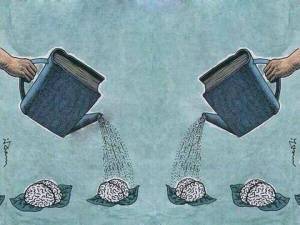
What I am going with this is that sometimes I read too much I can't write. Haha, that's just an excuse. No, I mean, it is important to keep myself, yourself, ourselves--to feed our brain as often as we feed our stomach. I don't know how to put it because now part of my brain is booing me because I may be wrong (considering some readers' response). But for me, personally, I do it to keep me sane. To keep my brain well-fed. To maintain to not stupid while I entertain myself. And I'm pretty much enjoy myself who love to seek some new knowledge, and science is a part of it.

Nerd? Good.
Weird? Brilliant.

Oh, and what I wanted to share with you is that just minutes ago, I found an article titled Scans Map The Brain As People Read Harry Potter.
Interesting fact number one is the technology can be used in the future to know what exactly the problem in one's brain with dyslexia, stroke, or learning trouble. Interesting fact number two is (wait this is what I implied, not stated in the article) reading is paramount. It activates a lot of brain cells to comprehend something we read, as I quote from the article: "Those findings suggest how words are integrated into memory--how the brain first visually perceives a word and then begins accessing the properties of the word and fitting it into the story context.".


That is one of the reasons why this year I'm excited for "a book a month" project. So far it has been going pretty well. This is, like, the first year I actually read a book a month and that feels really good. I want my future children to be smart. Since intelligence is inherited from the mother, I'm responsible to not make myself stupid in order to produce clever offspring. Aaand, of course, their father should be intelligent too so he can teach and show them profound life values.

Ookay, that was a long rambling passage. 
Here's a point: I do realize that there are many kinds of intelligence. I'm maybe good at linguistic and existential, but very sloppy in logical and intra/interpersonal intelligence. I guess the best thing for us is to embrace and maximize it as long as we live. Those what I wrote about is simply my way to add and sharpen my existing knowledge of science. Go find yours. ;)

Cheers!

Saturday, August 11, 2012

Death Is An Illusion

I found this article when I was eating at sahur time. As a scientist, my dad always curious about scientific journal and article (yaiyalah! :p). Not only his area of expertise, which is Oceanography, but also he attracts to science generally. He often print out one of the most interesting article and bring it home. So, this is one of them:

Is Death An Illusion? Evidence Suggests Death Isn't The End


After the death of his old friend, Albert Einstein said “Now Besso has departed from this strange world a little ahead of me. That means nothing. People like us … know that the distinction between past, present and future is only a stubbornly persistent illusion.”
New evidence continues to suggest that Einstein was right – death isan illusion.
Our classical way of thinking is based on the belief that the world has an objective observer-independent existence. But a long list of experiments shows just the opposite. We think life is just the activity of carbon and an admixture of molecules – we live awhile and then rot into the ground.
We believe in death because we’ve been taught we die. Also, of course, because we associate ourselves with our body and we know bodies die. End of story. But biocentrism – a new theory of everything – tells us death may not be the terminal event we think. Amazingly, if you add life and consciousness to the equation, you can explain some of the biggest puzzles of science. For instance, it becomes clear why space and time – and even the properties of matter itself – depend on the observer. It also becomes clear why the laws, forces, and constants of the universe appear to be exquisitely fine-tuned for the existence of life.
Until we recognize the universe in our heads, attempts to understand reality will remain a road to nowhere.
Consider the weather ‘outside’: You see a blue sky, but the cells in your brain could be changed so the sky looks green or red. In fact, with a little genetic engineering we could probably make everything that is red vibrate or make a noise, or even make you want to have sex like with some birds. You think its bright out, but your brain circuits could be changed so it looks dark out. You think it feels hot and humid, but to a tropical frog it would feel cold and dry. This logic applies to virtually everything. Bottom line: What you see could not be present without your consciousness.
In truth, you can’t see anything through the bone that surrounds your brain. Your eyes are not portals to the world. Everything you see and experience right now – even your body – is a whirl of information occurring in your mind. According to biocentrism, space and time aren’t the hard, cold objects we think. Wave your hand through the air – if you take everything away, what’s left? Nothing. The same thing applies for time. Space and time are simply the tools for putting everything together.
Consider the famous two-slit experiment. When scientists watch a particle pass through two slits in a barrier, the particle behaves like a bullet and goes through one slit or the other. But if you don’t watch, it acts like a wave and can go through both slits at the same time. So how can a particle change its behavior depending on whether you watch it or not? The answer is simple – reality is a process that involves your consciousness.
Or consider Heisenberg’s famous uncertainty principle. If there is really a world out there with particles just bouncing around, then we should be able to measure all their properties. But you can’t. For instance, a particle’s exact location and momentum can’t be known at the same time. So why should it matter to a particle what you decide to measure? And how can pairs of entangled particles be instantaneously connected on opposite sides of the galaxy as if space and time don’t exist? Again, the answer is simple: because they’re not just ‘out there’ – space and time are simply tools of our mind.
Death doesn’t exist in a timeless, spaceless world. Immortality doesn’t mean a perpetual existence in time, but resides outside of time altogether.
Our linear way of thinking about time is also inconsistent with another series of recent experiments. In 2002, scientists showed that particles of light “photons” knew – in advance – what their distant twins would do in the future. They tested the communication between pairs of photons. They let one photon finish its journey – it had to decide whether to be either a wave or a particle. Researchers stretched the distance the other photon took to reach its own detector. However, they could add a scrambler to prevent it from collapsing into a particle. Somehow, the first particle knew what the researcher was going to do before it happened – and across distances instantaneously as if there were no space or time between them. They decide not to become particles before their twin even encounters the scrambler. It doesn’t matter how we set up the experiment. Our mind and its knowledge is the only thing that determines how they behave. Experiments consistently confirm these observer-dependent effects.
Bizarre? Consider another experiment that was recently published in the prestigious scientific journal Science (Jacques et al, 315, 966, 2007). Scientists in France shot photons into an apparatus, and showed that what they did could retroactively change something that had already happened in the past. As the photons passed a fork in the apparatus, they had to decide whether to behave like particles or waves when they hit a beam splitter. Later on – well after the photons passed the fork – the experimenter could randomly switch a second beam splitter on and off. It turns out that what the observer decided at that point, determined what the particle actually did at the fork in the past. At that moment, the experimenter chose his past.
Of course, we live in the same world. But critics claim this behavior is limited to the microscopic world. But this ‘two-world’ view (that is, one set of physical laws for small objects, and another for the rest of the universe including us) has no basis in reason and is being challenged in laboratories around the world. A couple years ago, researchers published a paper in Nature (Jost et al, 459, 683, 2009) showing that quantum behavior extends into the everyday realm. Pairs of vibrating ions were coaxed to entangle so their physical properties remained bound together when separated by large distances (“spooky action at a distance,” as Einstein put it). Other experiments with huge molecules called ‘Buckyballs’ also show that quantum reality extends beyond the microscopic world. And in 2005, KHC03 crystals exhibited entanglement ridges one-half inch high, quantum behavior nudging into the ordinary world of human-scale objects.
We generally reject the multiple universes of Star Trek as fiction, but it turns out there is more than a morsel of scientific truth to this popular genre. One well-known aspect of quantum physics is that observations can’t be predicted absolutely. Instead, there is a range of possible observations each with a different probability. One mainstream explanation, the “many-worlds” interpretation, states that each of these possible observations corresponds to a different universe (the ‘multiverse’). There are an infinite number of universes and everything that could possibly happen occurs in some universe. Death does not exist in any real sense in these scenarios. All possible universes exist simultaneously, regardless of what happens in any of them.
Life is an adventure that transcends our ordinary linear way of thinking. When we die, we do so not in the random billiard-ball-matrix but in the inescapable-life-matrix. Life has a non-linear dimensionality – it’s like a perennial flower that returns to bloom in the multiverse.
“The influences of the senses,” said Ralph Waldo Emerson “has in most men overpowered the mind to the degree that the walls of space and time have come to look solid, real and insurmountable; and to speak with levity of these limits in the world is the sign of insanity.”


Well, that was quite long. But it is worth to read, don't you think?
Wait, sejak kapan gue jadi geek begini? (for God's sake, look at the new label!)

My point of view on the next post!

Cheers!